Radiology solved this thirty years ago: every patient gets one imaging archive, forever. We ported that discipline to culverts, bridges, pipes, and tanks — with the intelligence, the evidence, and the dollars computed from the record itself.
Self-serve: your tenant is provisioned in minutes · 24 inspection methods · runs air-gapped
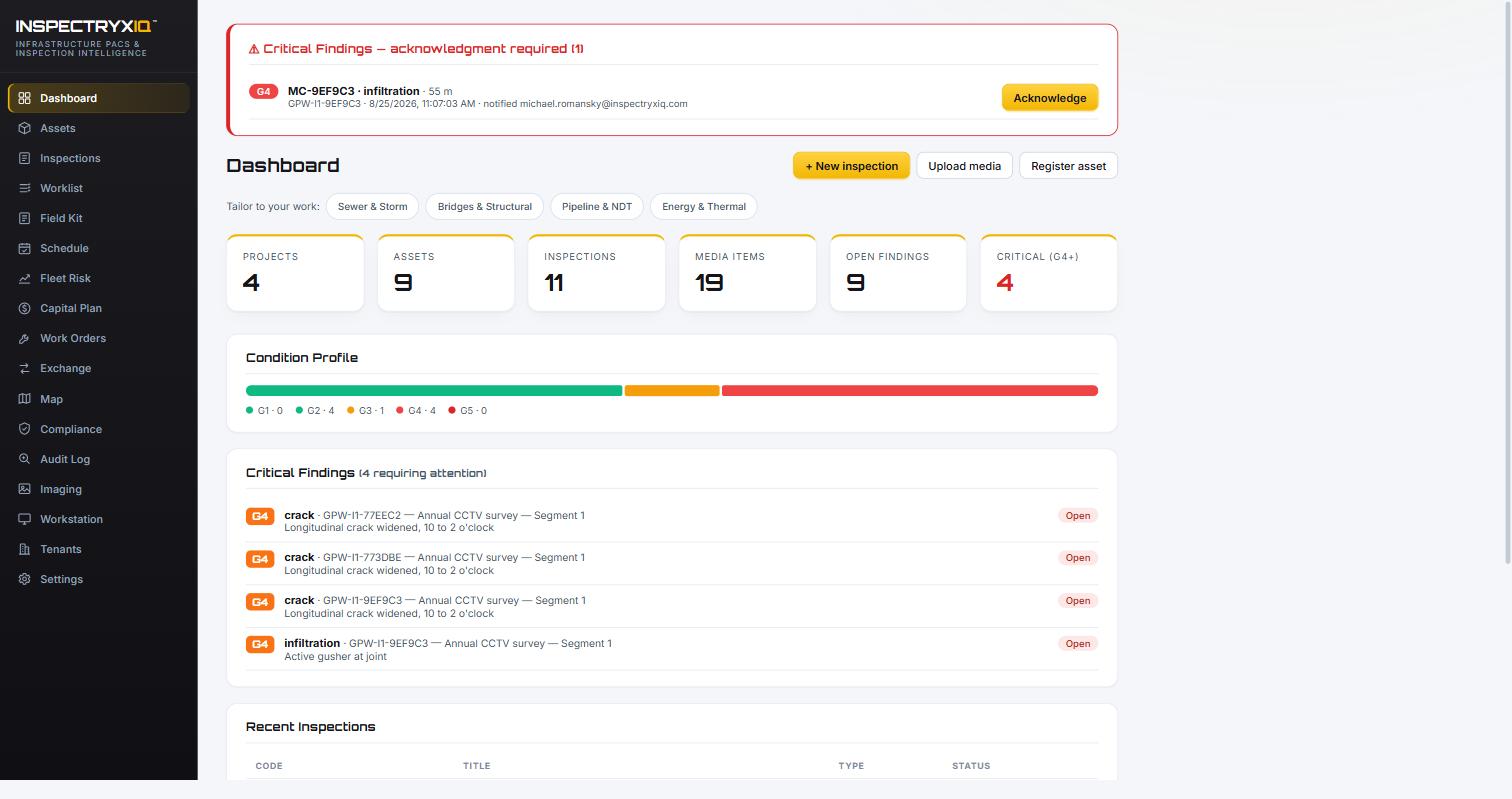
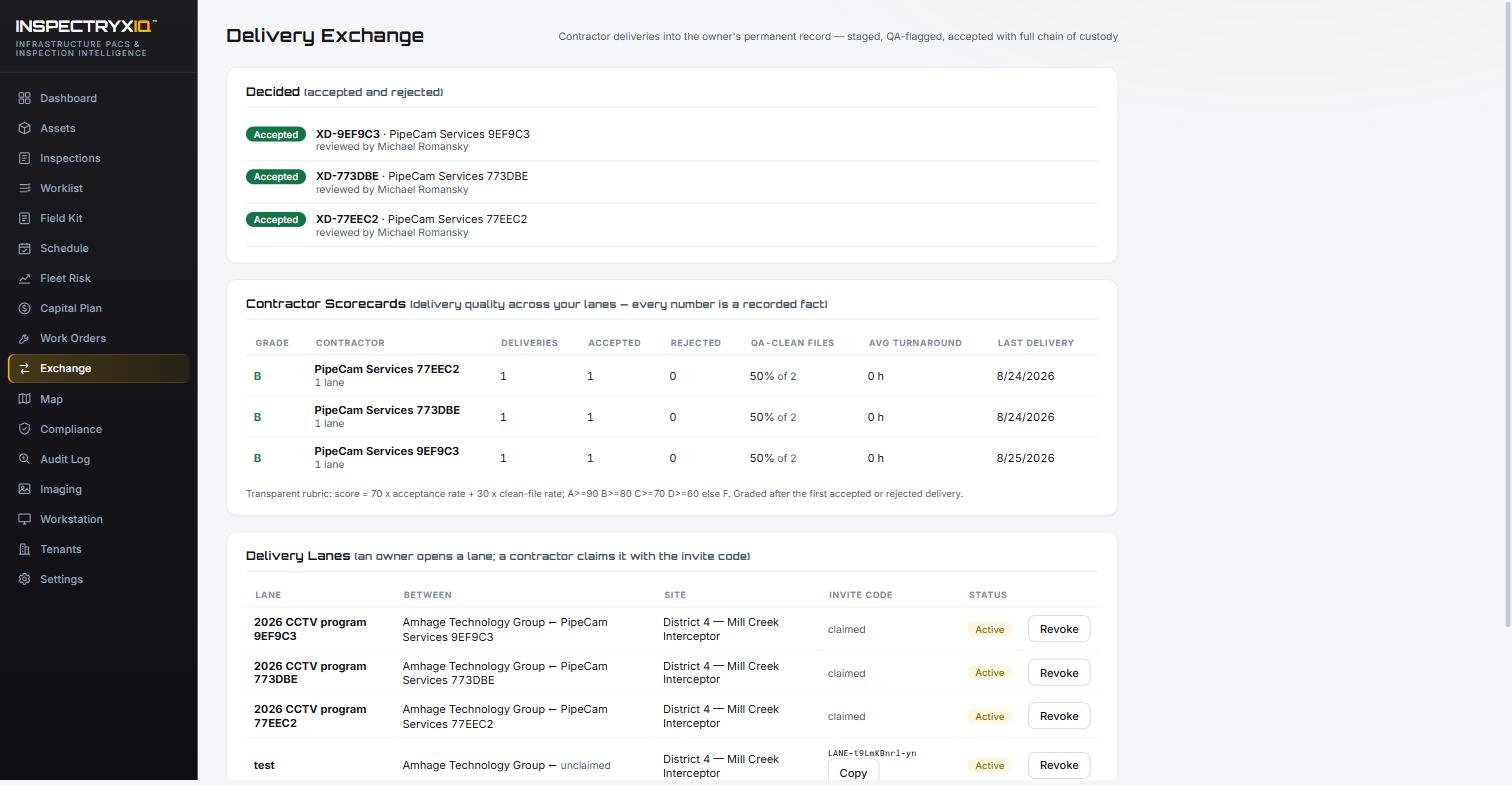
Not a sizzle reel. Both films are cut from live screens on the tenant a pilot actually runs on — with the coding standards, the decline rates and the dollar figures legible in frame.
Everyone in this market sells a better way to look at one inspection. Nobody sells the record. This one makes that case in two minutes and ends on the question worth asking every vendor you meet: what happens to your inspection records when you stop paying?
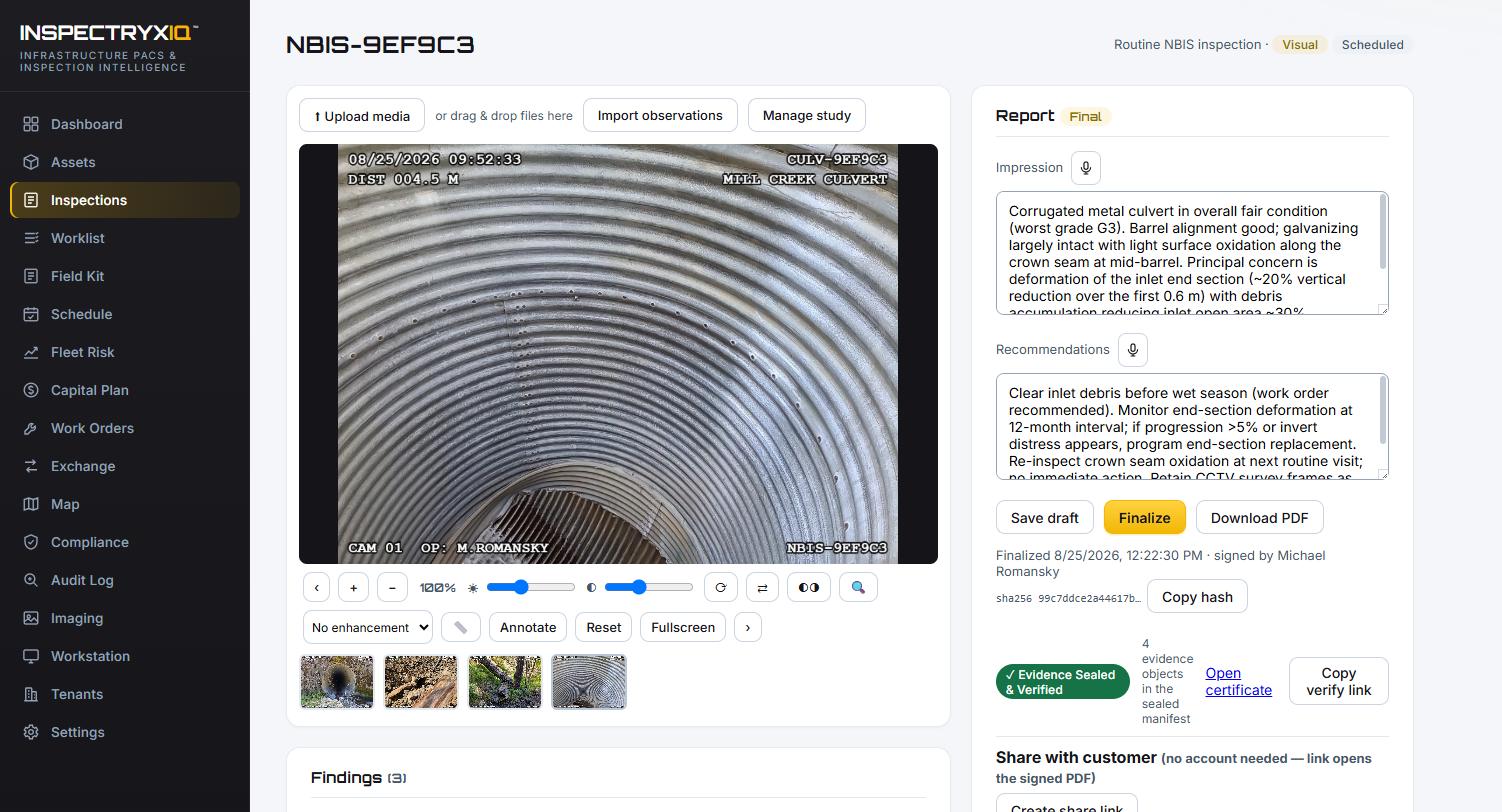
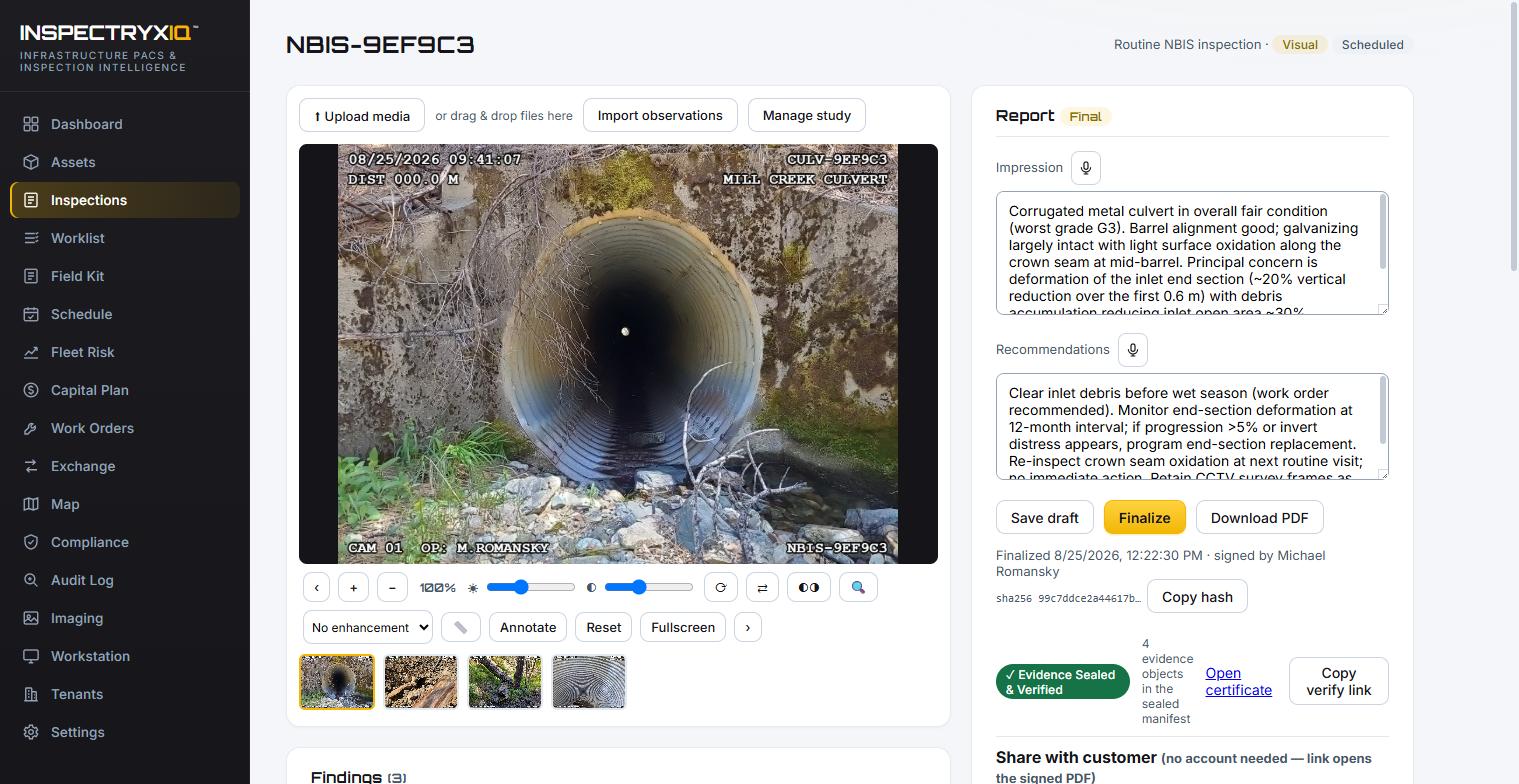
Every product screen is the shipping build on a live tenant. The culvert is the same photograph twice — in the field, then loaded into the record as the Mill Creek study. Remaining asset photography is licensed stock.
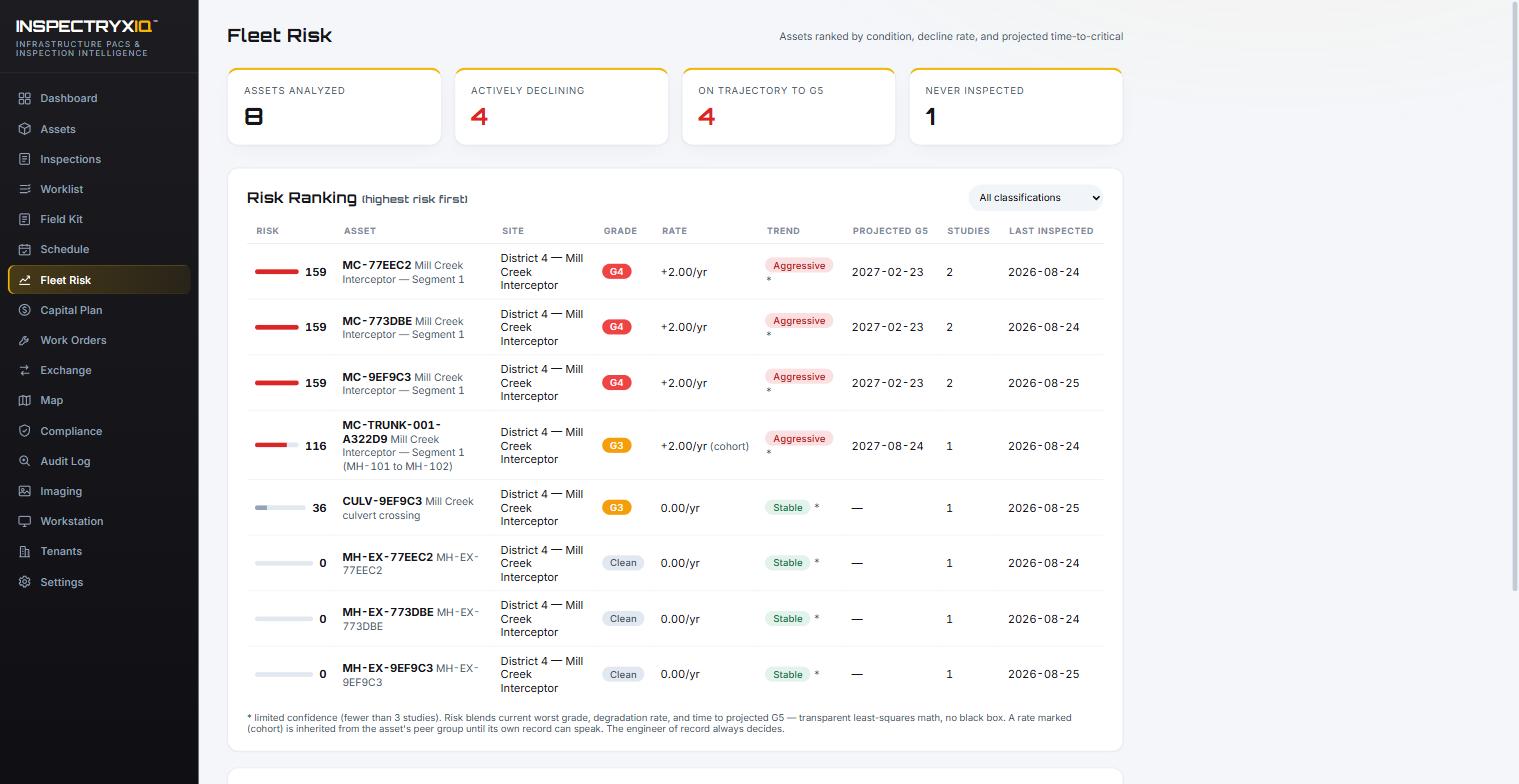
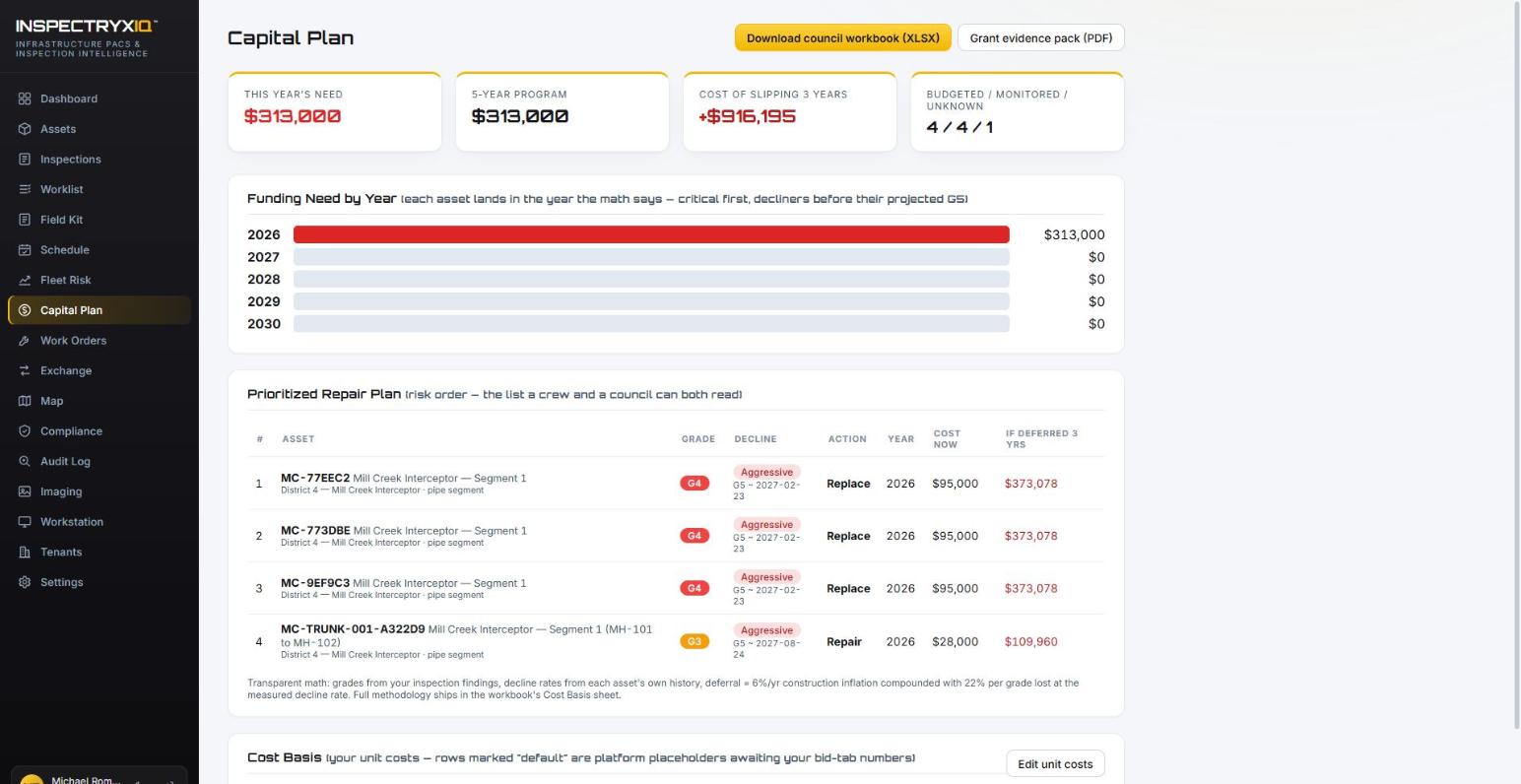
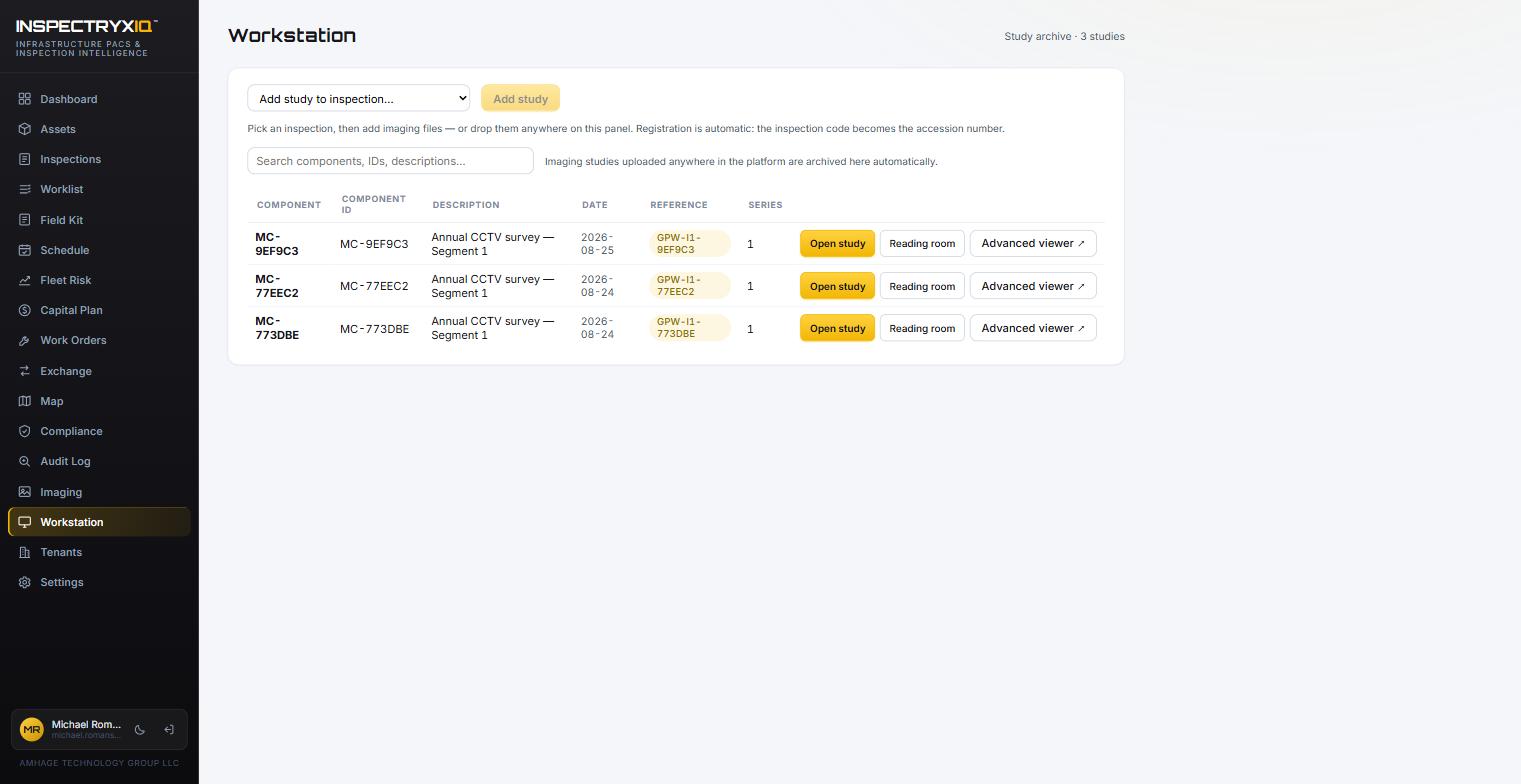
No mockups and no stock renders: every frame below is the shipping product on a live tenant — a routine NBIS culvert inspection with genuine field imagery in the reading room, coded findings, and the math computed from the record.
Study imagery: genuine field photography of an in-service culvert, ingested through the product's own upload lane, coded, graded, and sealed like any study.
CCTV drives, drone folders, PDF reports, contractor hand-offs. When someone asks what this culvert looked like in 2022, the honest answer is a shrug.
AI coding vendors grade one video brilliantly — then move on. Nobody holds the multi-year record, so nobody can say whether anything is getting worse.
When a failure ends up in litigation or an audit, folders of unverifiable files don't stand up. Who took this? When? Has it been altered?
Repair lists built from memory and squeaky wheels — not measured deterioration. Councils can tell.
The asset is the patient. Nobody keeps the chart.
Every hospital keeps one permanent imaging archive per patient — every study, every reader, every report. The same architecture runs here.
| RADIOLOGY PACS | INSPECTRYXIQ™ |
|---|---|
| Patient | Asset — culvert, bridge, pipe, tank… |
| Modalities: CT, MRI, X-ray | CCTV, drone, LiDAR, thermal, radiography (DICONDE) — 24 methods |
| Structured reporting (BI-RADS) | IXQ-SRT coded findings with measured values — every report is queryable data |
| Prior studies auto-loaded | Prior inspections auto-loaded, aligned comparison + change heatmaps |
| Critical results → physician paged | G4+ finding → engineer paged, acknowledgment logged |
| Signed report, immutable archive | Sealed report + Evidence Integrity Certificate — SHA-256, public verification |
App upload, watched hot folders, field gateways, DICONDE push — and an installable offline field kit that works in a culvert with no signal. Every file hashed at the door.
The permanent multi-modality archive: Asset 360, priors auto-loaded, a true diagnostic workstation, coded findings the inspector can dictate by voice.
Degradation rate per asset, defect progression tracks, projected time-to-critical, fleet risk ranking — and cohort curves so new assets get intelligence on day one.
Sealed reports, Evidence Integrity Certificates, public hash verification, critical-results paging with logged acknowledgment.
Contractors deliver into your archive through QA'd lanes — chain of custody intact — and every contractor is graded A–F from their real delivery data.
The 5-year risk-ranked capital plan with deferral penalties, the council-ready workbook, and one-click grant evidence packs for federal applications.
Is it getting worse, how fast, and when does it go critical? Transparent least-squares math from the asset's own record — never a black box.
Every asset ranked by condition, decline rate, and time-to-critical. The ten assets that will hurt you next, on one screen.
Fleet risk × your unit costs = the prioritized 5-year plan with deferral penalties. Fix it now, or pay double later — exported council-ready.
Every file SHA-256-hashed at entry with chain of custody. Anyone verifies live, no account. Tampering shows as ALTERED, in red.
Contractors deliver straight into your archive through QA'd lanes — duplicates flagged, custody recorded — and get graded A–F from the data.
A true DICONDE engine: radiography into a real archive with a branded viewer, window/level, and measurements. Industrial imaging done properly.
IXQ-SRT: a controlled observation vocabulary across all 24 methods. Coded findings with measured values — every report becomes queryable data.
"Crack at twelve meters, grade three, width two millimeters" becomes a coded draft the inspector confirms. Deterministic and air-gap-safe.
Your archive, analyzed as a population: how do YOUR 1960s culverts age? New assets inherit their cohort's curve on day one.
One click assembles the submission exhibit — histories, trend charts, sealed certificates, photos, deferral dollars. Weeks of assembly, gone.
Federal element-level condition states with enforced arithmetic and the element CSV your DOT expects. Built for county bridge programs.
An installable app that captures findings, photos, and voice notes with zero signal — then syncs with full custody stamps.
NYC FISP, Chicago, Boston, Philadelphia. Each city's own classification wording, its filing window, and the SWARMP rule that catches people out: the same condition cannot be deferred twice.
AHERA, NESHAP and New York ICR 56 kept deliberately apart — three regimes, three clocks, no shared values. Minimum sample counts, the one-percent rule, notification lead times, and the retention clock that does not start until the last ACBM is gone.
TOTP with recovery codes, verified against the RFC 6238 test vectors, and an organisation-wide requirement an administrator can switch on. Blocks changes, never sign-in.
Multi-tenant and white-label. Deploys on a laptop, a county server, or the cloud — including fully sealed air-gapped networks with zero external calls.
Sewer, storm, culverts, bridges. The win: the council workbook, grant packs, and the critical-results log.
Bridge and culvert programs at fleet scale — NBIS discipline, element-level data, prime/sub delivery chains.
PACP-coded CCTV programs, consent-decree documentation, air-gapped networks. Evidence certificates answer the regulator.
White-label the platform, deliver through lanes into every client, keep the portal of everything ever delivered.
NYC Local Law 11 and the Chicago, Boston and Philadelphia ordinances. Five years between cycles is a long time for a filing cabinet to remember what it deferred.
A survey before every demolition, renovation and repair, billed per job. The sample is the record; the photograph hangs off it. Proving you looked is the part that fails, not the looking.
Published plans from $3,900/year — and contractors invited by their clients join free, forever. See the prices.
We surveyed thirteen vendors in this category in August 2026. One other publishes a real dollar figure. Everyone else says “contact us” — which means a salesperson learns your budget before you learn their price.
$3,900/year
Up to 1,500 assets, 3 named users. For a survey practice billing per job — facade cycles, asbestos surveys — rather than a town with a software budget. Month to month $390.
$9,900/year
Up to 2,500 assets, 5 named users. Sized for towns and firms up to about 10,000 people. Month to month $990.
$19,900/year
Up to 25,000 assets, 25 named users. Sized for 10,001 to 75,000 people. Adds condition intelligence, fleet risk, capital planning, white-label. Month to month $1,990.
from $49,000/year
Unlimited assets and users, air-gapped deployment, SNBI bridge mode, reseller rights, purchase order and invoiced billing.
Unlimited, permanent, for the life of the asset. Published rate cards elsewhere in this category bill cloud storage by the gigabyte per year — and inspection video is not a small number of gigabytes.
Loading your existing records is part of the price. In the public contracts we reviewed it is always a separate line, and it is rarely a small one.
Give every one of your own clients a branded read-only portal. Those logins never count against your seats.
If it lapses, you keep reading. Stop paying and the workspace becomes read-only: every record stays where it is, readable and exportable, indefinitely. You lose the ability to add. You never lose the ability to retrieve a report you signed. Ask any other vendor in this category the same question before you sign with them.
Find a lower published price for comparable scope and send it to us. We will match it or tell you plainly why we cannot, and that answer will be useful to you either way.
Every piece of civil infrastructure — every culvert, bridge, pipe, and tank — deserves a lifelong diagnostic record, the way every patient deserves a chart. When the record exists, decline is caught early, budgets follow evidence, and failures stop being surprises.
Build the system of record for infrastructure condition: a permanent multi-modality archive with the intelligence, the evidence, and the dollars computed from it — deployable anywhere, from a county server to a sealed air-gapped network.
Every claim traces to a study, a hash, a timestamp. If it isn't in the record, it isn't an answer.
Transparent least-squares math you can check by hand. An engineer should never have to trust a number they can't derive.
The platform ranks, projects, and drafts — the engineer of record confirms, dismisses, and signs. Always.
Your data on your hardware if you choose — laptop, county server, or fully air-gapped network with zero external calls.
Infrastructure lives for 80 years; its record must outlive every vendor. Open standards — DICOM/DICONDE — so the archive is portable forever.
From the field camera to the council vote, every hand-off is hashed and logged. Chain of custody is a feature, not a promise.
InspectryxIQ™ is built by Amhage Technology Group LLC, an independent software company in Rochester, New York. We build at the intersection of two disciplines: the archival rigor of medical imaging systems, and the field reality of civil infrastructure inspection.
Michael Romansky — Founder
Michael founded Amhage Technology Group to bring the discipline of the hospital PACS — one permanent record, structured reporting, sealed evidence — to the infrastructure that everyone drives over and nobody can see inside. He leads product and engineering.
Own the record, and everything else follows.
Start free, self-serve: your own tenant is provisioned in minutes. Load one site and your last three years of inspection files — see your own deterioration curves in a week.